Why Breathing Exercises Fail During a Panic Attack
“Just breathe” is the most common piece of advice given to someone in a panic attack, and it’s also one of the least useful, not because breathing doesn’t matter, but because of how it’s usually offered.
The instruction assumes a version of you that isn’t there yet
A panic attack is a real, measurable physiological event. Your sympathetic nervous system activates as if you’re facing a genuine threat: heart rate climbs, blood moves toward large muscle groups, and higher-order cognitive processing, the part of your brain that would normally follow a multi-step instruction calmly, gets deprioritized in favor of faster, more reflexive systems.
This is the part that generic breathing advice misses. “Take a deep breath” asks something of your prefrontal cortex at the exact moment your body has temporarily handed control to a much older, faster system. It’s not that you’re failing to follow good advice. The advice was built for someone who isn’t mid-panic.
Not all breathing techniques are equal, and the difference is measurable
Here’s the part that rarely makes it into general anxiety advice: research has actually compared different breathing protocols directly against each other, and they don’t perform the same.
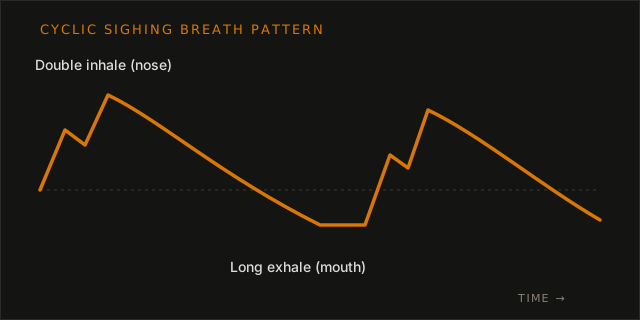
A 2023 study out of Stanford compared several brief daily practices, cyclic sighing, box breathing, and mindfulness meditation, against each other over a month. Cyclic sighing (a double inhale through the nose followed by one long exhale through the mouth) produced greater improvements in mood and greater reductions in resting respiratory rate than either box breathing or meditation.
The mechanism matters here. A cyclic sigh specifically targets the physiological signature of acute stress: shallow, rapid breathing with underinflated lungs. The double inhale re-expands collapsed alveoli, and the long exhale is what actually drives the parasympathetic (calming) response, not the inhale. Most generic breathing advice doesn’t specify this. It just says “breathe deeply,” which can even make things worse if it’s done as a single deep breath without the extended exhale that’s doing the real work.
Common breathing mistakes people make in the moment
A few habits show up constantly in how people try to self-correct during a panic attack, and most of them make the physiology worse rather than better.
The most common one is a single big gasp: one large, fast inhale meant to “get more air in.” It feels intuitive, since panic often comes with a sensation of not getting enough oxygen. But that sensation isn’t usually caused by too little oxygen. Research on hyperventilation in panic disorder has found that panic symptoms are more closely tied to a drop in carbon dioxide from breathing too fast and too shallow, not a lack of oxygen, and a sudden big inhale adds to that imbalance instead of correcting it. This is also why some people feel dizzy or get tingling in their hands during a panic attack. That combination is a hallmark sign of low CO2 from overbreathing, not a sign of an actual medical emergency, though it understandably feels like one in the moment.
Related to this is straight overbreathing: short, rapid breaths stacked on top of each other with no real exhale in between. One influential theory of panic, proposed by psychiatrist Donald Klein in 1993, argues that some panic attacks are triggered by a misfiring “suffocation alarm,” a biological system that reacts to rising carbon dioxide as though you’re being smothered even when you aren’t. Whatever the exact trigger, overbreathing keeps carbon dioxide swinging in the same low range linked to panic symptoms like dizziness and tingling, so it tends to prolong a spike rather than resolve it.
A third pattern is breath-holding. Some people, without realizing it, tense up and briefly stop breathing altogether when panic spikes. This doesn’t calm the nervous system down either. It just delays the same overbreathing pattern by a few seconds before it restarts, often more intensely.
The fix in all three cases isn’t more air. It’s a longer exhale relative to the inhale, which is the part of the breath that actually signals the parasympathetic nervous system to slow things down. One practical way to tell if you’re doing this wrong in the moment: put a hand on your stomach. If your shoulders are rising and falling fast while your stomach barely moves, that’s shallow, chest-based breathing, the exact pattern linked to hyperventilation symptoms. Shifting the movement down into the stomach and slowing the exhale matters more than which specific technique you’re following.
Why the moment itself needs a different design, not just better instructions
None of this means breathing techniques don’t work. It means the delivery matters as much as the technique. Someone mid-panic needs:
- A specific, validated protocol, not a vague instruction to relax
- Something that requires almost no cognitive load to follow, since that’s exactly what’s temporarily reduced
- Real feedback that it’s working, since panic itself often includes the fear that nothing will help
This is the actual design problem behind Crisis Mode’s breathing sequence in PAUS: the cyclic sigh pattern, paired with a real-time heart rate reading pulled from your phone’s camera, so the drop in your own heart rate becomes visible evidence, not just an instruction to trust.
If you’re building your own calming practice outside of any app, the cyclic sigh technique alone, done for even 60 seconds, is one of the few breathing interventions with real head-to-head evidence behind it. Long exhale, longer than the inhale, is the part that matters most.
References
- [1] Balban, M.Y., Neri, E., Kogon, M.M., et al. Brief structured respiration practices enhance mood and reduce physiological arousal. Cell Reports Medicine, 2023.
- [2] Klein, D.F. False suffocation alarms, spontaneous panics, and related conditions: An integrative hypothesis. Archives of General Psychiatry, 1993;50(4):306-317.
- [3] Meuret, A.E., Ritz, T. Hyperventilation in panic disorder and asthma: Empirical evidence and clinical strategies. International Journal of Psychophysiology, 2010;78(1):68-79.
Related reading
About the author
Notes on the nervous system science behind PAUS, written for people who want the real evidence, not just the reassurance.