Meditation vs Crisis Intervention: Which Do You Need?
Meditation has real, well-documented evidence behind it. Regular practice is genuinely associated with lower baseline anxiety over time. None of that is in question. What’s worth separating out is a distinction that most anxiety content glosses over: the difference between building a calmer baseline over time, and needing something that works in an acute moment, right now, while it’s happening.
Two different jobs
Think of it like general fitness versus a first-aid kit. Regular exercise genuinely improves your long-term health, your cardiovascular resilience, your recovery capacity. But if you’re actively bleeding, general fitness isn’t the tool you reach for. You need something built specifically for the acute moment.
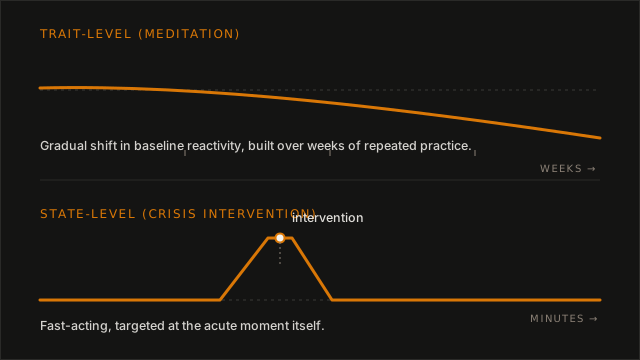
Meditation, and most meditation apps, are built for the first category: trait-level change, a gradual shift in your baseline reactivity, built through regular, unhurried practice done when you’re already in a reasonably calm state. That’s a real and valuable thing to build. It’s just a different mechanism than what’s needed during an actual panic spike.
A panic attack is a state-level event: acute, physiological, often peaking within minutes. It calls for something different, fast to access, low cognitive load, and specifically built to address the physical surge that’s happening right then, not a practice meant to be built gradually over weeks.
What the research actually says about meditation’s limits during acute panic
It’s worth being precise about what the evidence for meditation actually measures, because it’s easy to round it up to more than it says. The most cited meta-analysis on mindfulness-based therapy, pooling 39 studies, found a moderate effect on anxiety symptoms, roughly a medium-sized improvement compared to control conditions. That’s a real, meaningful result. But look at how it was measured: symptom scores taken before a course of treatment and again after it ended, typically after weeks of structured practice. It’s evidence that repeated practice shifts your baseline. It isn’t evidence about what happens if you open a meditation app in the middle of a panic attack, because that’s not what the studies were testing.
This traces back to how mindfulness-based programs were built in the first place. The original clinical mindfulness program, developed by Jon Kabat-Zinn in the early 1980s for chronic pain patients, was structured as a multi-week outpatient course: guided sessions plus daily home practice, building capacity over an extended period. Every major program that followed it, including the mindfulness-based stress reduction and mindfulness-based cognitive therapy protocols used in most published research, kept that same structure. Mindfulness-based cognitive therapy, the version most often studied for relapse prevention, is typically delivered as eight weekly two-hour sessions plus daily homework, reinforcing that the entire evidence base for meditation’s anxiety benefits assumes a multi-week arc, not a single-use emergency tool reached for mid-panic.
That’s not the same as saying meditation “doesn’t work” during a panic attack. It’s that the research mostly hasn’t tested that specific moment, so there isn’t strong evidence either way about using it as a rescue tool. The absence of evidence for acute use is a different claim than evidence of absence, and generic anxiety content often blurs the two. What the research does support clearly is the trait-level claim: consistent practice over time is associated with a lower baseline and fewer or less intense episodes. Whether a short guided meditation started mid-spike does anything meaningful in that specific window is a much less settled question, and treating it as settled either way overstates what’s actually been studied.
This is a good reason to separate the two goals explicitly rather than expecting one tool to do both. If you already have a regular meditation practice, keep it. The trait-level evidence for it is solid. But treating it as your plan for the exact moment a panic attack starts is asking the tool to do a job it was never tested for, not a job it’s been shown to fail at.
Why this distinction gets lost
Most anxiety apps position themselves as one general tool for “anxiety,” without separating which of these two jobs they’re actually doing. A well-designed meditation practice, done consistently, can genuinely lower how often panic happens and how intense it is when it does. But if someone opens a meditation app in the middle of an actual panic attack expecting immediate relief from a practice designed for a calm baseline state, the mismatch isn’t the app’s fault or the person’s failure. It’s a mismatch between the tool and the moment.
What an acute moment actually needs
During a real panic spike, the more useful things tend to be:
- Fast, low-effort grounding, something that doesn’t require calm focus to begin
- Real physiological feedback, evidence that the body is actually responding, not just an instruction to trust that it will
- Something specifically designed for a public setting or a moment when reading a screen isn’t realistic
This is a different design brief than a 10-minute guided meditation, and it’s why PAUS treats Crisis Mode as a genuinely separate system from its daily training, built around what an acute moment actually requires, rather than trying to make one generic practice do both jobs.
Both approaches have real value. The point isn’t that one replaces the other. It’s that knowing which moment you’re in changes which tool is actually going to help.
References
- [1] Hofmann, S.G., Sawyer, A.T., Witt, A.A., Oh, D. The effect of mindfulness-based therapy on anxiety and depression: A meta-analytic review. Journal of Consulting and Clinical Psychology, 2010;78(2):169-183.
- [2] Kabat-Zinn, J. An outpatient program in behavioral medicine for chronic pain patients based on the practice of mindfulness meditation: Theoretical considerations and preliminary results. General Hospital Psychiatry, 1982;4(1):33-47.
Related reading
About the author
Notes on the nervous system science behind PAUS, written for people who want the real evidence, not just the reassurance.